


Schließen


China’s car imports and exports continue to grow
China’s auto imports and exports continued their growth trend steadily, the China Association of Automobile Manufacturers (CAAM) reported. In October 2020, new car trade increased by 48.9 percent year-on-year. Trade value amounted to $15.33 billion, a slight decrease of 2 percent compared to the previous month, according to customs data analysis. Specifically, auto imports rose 73.3 percent compared to October 2019 to $8.33 billion while exports also increased 27.5 percent to about $7 billion.
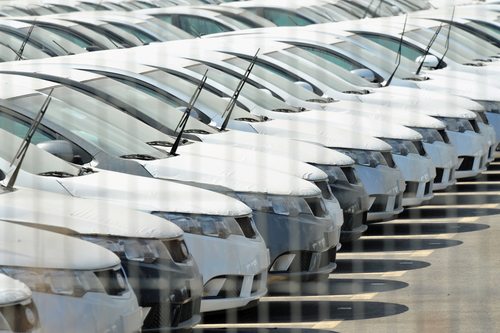
In the first ten months of 2020, CAAM put the value of auto imports and exports at a total of $118.37 billion. This represents a decrease of 8 percent, but there were only declining figures in the January to September period. The automotive market in China was also affected by the impact of the Covid 19 pandemic but recovered from April. CAAM cites pent-up demand from interested customers as well as support and purchase incentives from the Chinese government as the reason. As a result, after a lean period of 21 months, sales also rebounded by 4.4 percent compared to April 2019.
Dealers of luxury vehicles managed to sell 277,000 cars in April last year, up 11 percent year-on-year. Luxury vehicles accounted for about 19 percent of total new vehicle sales in April, up 3.6 percent from a year ago. Alternative-drive vehicles broke a 12-month downward trend in July. Year-over-year sales of electric cars rose 24.2 percent to 79,000, while plug-in hybrids increased 2.7 percent to 19,000 vehicles. The number of charging stations nationwide is 566,000, with 7,800 new installations in July alone.
Vehicles and components must be awarded a CCC certificate in order for the products to be exported to China or manufactured locally. The CCC certificate was introduced in 2002 and is comparable to the European CE marking. If you need CCC certification in the automotive sector, China Certification is an excellent partner for you. We have been advising leading automotive suppliers and vehicle manufacturers on their CCC certifications for years.
For more information on how CCC certification, the CCC Self-Declaration and voluntary CCAP or CQC certification may affect your company, or for more information about CCC certification in general, the process, and the associated costs, please visit our website and our News Section where you will find current updates twice a week.
Please do not hesitate to contact us for further details and consultation. You can contact us via e-mail, or call us (UK: +44 2071931135, Rest of Europe: +49 69 2713769150, US: +1 773 654-2673).
Please don’t hesitate to also use our chat-window in the bottom right corner if you have any questions. (Please check your browser settings if you can’t see the window)
You can also check out our free CCC-Brochure, which can be downloaded right here as a PDF file or you consult our book (in English) “A Brief Guide to CCC: China Compulsory Certification”, which can be found directly here on Amazon.
Here you can download our brochure about the CCC Self-Declaration.
Here you can download our brochure about the voluntary CCAP or CQC certification.
Steel sector in China shows increased production during 2020
The steel sector in China saw a slight increase during the first 10 months of 2020, according to industry data analysis. Crude steel output grew 5.5 percent year-on-year and now stands at 874 million tons, the China Steel and Iron Producers Association reported. Pig iron output increased 4.3 percent year-on-year and now stands at 742 million tons. The association expects that by the end of 2020 more than 1 billion tons of crude steel could be produced. This represents an annual increase from 3 to 5 percent.
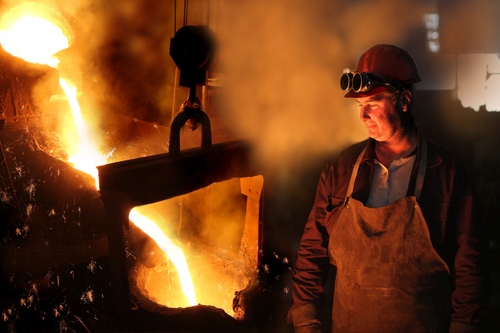
In 2018, China was the world’s largest steel producer, responsible for more than half of global steel production. China produced around 928 million tons of steel in 2018, doubling its capacity in ten years. Six of the top ten steel producers are located in China. Domestic iron ore mining was still able to meet demand until the early 1990s, but was soon overtaken by imported iron ore. The majority of steel production takes place in numerous smaller industrial centers, the largest of which is located in Anshan in Liaoning Province.
China’s steel exports peaked in 2015 at 110 million tons. After that, the volume slowly but steadily declined. In 2018, the volume was only 66.9 million tons, an increase of 9 percent compared to the previous year. As early as 2012, while the Chinese steel industry was still being established, numerous countries imposed anti-dumping duties to make it more difficult to import cheap steel from China. For 2018, the Chinese steel industry reported profits of around $70 billion, up 39 percent from the previous year. Domestic demand for steel remains stable, partly due to numerous infrastructure and construction projects in Xinjiang Autonomous Province in western China. The central government has set up several special economic zones there around the provincial capital of Urumqi, as well as pressing ahead with the expansion of the international airport and a station for high-speed trains.
Certain product groups such as steel and iron products must be awarded a CCC certificate in order for the products to be exported to China. The CCC certificate was introduced in 2002 and applies to both imported and Chinese products. The Chinese CCC is comparable to other certifications for standardizing product quality, such as the European CE system, but there are important differences.
For more information on how CCC certification, the CCC Self-Declaration and voluntary CCAP or CQC certification may affect your company, or for more information about CCC certification in general, the process, and the associated costs, please visit our website and our News Section where you will find current updates twice a week.
Please do not hesitate to contact us for further details and consultation. You can contact us via e-mail, or call us (UK: +44 2071931135, Rest of Europe: +49 69 2713769150, US: +1 773 654-2673).
Please don’t hesitate to also use our chat-window in the bottom right corner if you have any questions. (Please check your browser settings if you can’t see the window)
You can also check out our free CCC-Brochure, which can be downloaded right here as a PDF file or you consult our book (in English) “A Brief Guide to CCC: China Compulsory Certification”, which can be found directly here on Amazon.
Here you can download our brochure about the CCC Self-Declaration.
Here you can download our brochure about the voluntary CCAP or CQC certification.
Taiwan auto market reports highest sales in 15 years
Taiwan’s auto market defied the Covid 19 pandemic to reach a record 457,000 new cars sold in 2020, the highest sales figures since 2006, the China Times newspaper reported. According to the vehicle licensing authority, 457,435 new vehicles were registered last year, up 4 percent compared to 2019. Broken down by manufacturer, Toyota leads sales in Taiwan with 27 percent market share followed by Nissan with 7.7 percent. Honda (6.7 percent), Mercedes-Benz (6.5 percent) and Ford (6.3 percent) ranked next. Together, Toyota and Lexus sold 146,000 cars and owned 32 percent of the market.

The Toyota RAV 4, which sold 31,000 units, overtook the Toyota Altis (marketed in Europe as the Corolla), which had held the top spot for 19 years and sold 29,000 units, as the best-selling model in Taiwan. However, the RAV 4 may soon be displaced from its top spot, as the locally manufactured Toyota Corolla Cross in Taiwan is showing good sales figures. Only available since October 2020, 12,000 vehicles have already been sold in three months and insiders expect around 40,000 vehicles to be sold this year. The Corolla Cross is based on the Corolla’s current E210 platform and is positioned between the C-HR and RAV 4.
In terms of luxury vehicles, Mercedes-Benz is in first place with 29,000 vehicles, followed by Lexus and BMW with 22,000 and 18,000 vehicles each. Newcomer Tesla sold 5,819 vehicles, positioning itself in the top 5. Last year, 215,000 imported new vehicles were sold, representing a market share of 47.2 percent. All foreign manufacturers or their imported vehicles recorded rising sales figures, with VW subsidiary Skoda selling 7,041 vehicles. This corresponds to a growth of 22 percent compared to the previous year and is the company’s best result to date since its market launch in Taiwan.
In order to import products into Taiwan, it must be ensured that they meet safety and quality standards in Taiwan. This is ensured by specific, product-dependent certifications, which certify that the products comply with the relevant regulations in Taiwan. The Vehicle Safety and Certification Center (VSCC) is responsible for vehicles and products in the automotive industry in Taiwan. The authority was established in 2009 by the Ministry of Transport and Communications in the city of Lugang in Taiwan. In its scope, the VSCC certification for Taiwan are similar to the Chinese CCC and CEL certifications.
MPR China Certification GmbH has many years of experience in Taiwan certification and competent local partners. We will be pleased to advise you without obligation about the scope and procedure of a Taiwan certification.
Please do not hesitate to contact us for further details and consultation. You can contact us via e-mail, or call us (UK: +44 2071931135, Rest of Europe: +49 69 2713769150, US: +1 773 654-2673).
You can also check out our free Taiwan-Brochure, which can be downloaded right here.
Please don’t hesitate to also use our chat-window in the bottom right corner if you have any questions. (Please check your browser settings if you can’t see the window)
Authorities in China closed for Chinese New Year
In 2021, Chinese New Year will take place on February 12, 2021. which heralds the beginning of the Year of the Ox. The timing of the holiday, also known as the Spring Festival, is determined by the lunar calendar and thus varies each year. On China’s most important holiday, Chinese authorities are often closed several days in advance to allow employees enough travel time back home.
This year, the Chinese authorities are again closed for several days. According to official information, the CQC (China Quality Certification Centre) will close from Feb. 11 to Feb. 17, 2021, inclusive, and test labs will also be closed during this period. The CCAP (China Certification Centre for Automotive Products) will also close from 10.02.2021 up to and including 17.02.2021. Delays are therefore to be expected for ongoing certification processes.
MPR China Certification GmbH in Germany, as well as the subsidiaries in the US and China will be open and working as usual. We will gladly continue to support you with your certification processes during Chinese New Year.
For more information on how CCC certification, the CCC Self-Declaration and voluntary CCAP or CQC certification may affect your company, or for more information about CCC certification in general, the process, and the associated costs, please visit our website and our News Section where you will find current updates twice a week.
Please do not hesitate to contact us for further details and consultation. You can contact us via e-mail, or call us (UK: +44 2071931135, Rest of Europe: +49 69 2713769150, US: +1 773 654-2673).
Please don’t hesitate to also use our chat-window in the bottom right corner if you have any questions. (Please check your browser settings if you can’t see the window)
You can also check out our free CCC-Brochure, which can be downloaded right here as a PDF file or you consult our book (in English) “A Brief Guide to CCC: China Compulsory Certification”, which can be found directly here on Amazon.
Here you can download our brochure about the CCC Self-Declaration.
Here you can download our brochure about the voluntary CCAP or CQC certification.
Total Ban on Imports of Solid Waste in China
The Law of the People’s Republic of China on the Prevention and Control of Environmental Pollution by Solid Waste was implemented on September 1, 2020. The new law includes:
- Complete prohibition of the importation of solid waste from outside of China into China for dumping, depositing or disposal.
- Ministry of Ecology and Environment shall stop accepting and approving applications for import licenses for solid wastes that can be used as raw materials in restricted import categories.
- Customs special supervision areas and bonded places of supervision within the unit generated by the solid waste not shipped out of the country, in accordance with the relevant provisions of domestic solid waste management. The unshipped solid waste produced by units in the special customs supervision area and bonded supervision area (Including bonded area, comprehensive bonded area and other special customs supervision area and bonded logistics center, type A/B, bonded warehouses and other bonded area of supervision) shall be managed in accordance with the relevant domestic solid waste regulations. For solid waste that needs to be stored, utilized or disposed of outside the area, relevant procedures should be handled with the local government’s administrative department of special customs supervision area and bonded supervision area, and the customs will no longer check relevant approval documents.
- For solid wastes generated in the course of production operations by units carrying out bonded repair and remanufacturing operations outside the special supervisory areas and bonded supervisory sites of the Customs that have not been re-shipped out of the country, please refer to the provisions of paragraph 3.
This announcement was implemented on January 01, 2021.
The result of the announcement is that no GACC/ AQSIQ licenses for exporters of solid recycling material are issued anymore and old licenses become invalid.
Please do not hesitate to contact us for further details and consultation. You can contact us via e-mail, or call us (UK: +44 2071931135, Rest of Europe: +49 69 2713769150, US: +1 773 654-2673).
Please don’t hesitate to also use our chat-window in the bottom right corner if you have any questions. (Please check your browser settings if you can’t see the window)
You can also check out our free CCC-Brochure, which can be downloaded right here as a PDF file or you consult our book (in English) “A Brief Guide to CCC: China Compulsory Certification”, which can be found directly here on Amazon.
Here you can download our brochure about the CCC Self-Declaration.
Here you can download our brochure about the voluntary CCAP or CQC certification.
CQC issues general certification rules for CCC Self-Declaration products
On October 30, 2020, the China Quality Certification Center (CQC) issued General Certification Rules for Type II CQC Certification, designated CQC12-000001-2020.
These regulations for the Type II voluntary certification contain the requirements for the applicant regarding the technical person in charge , technical requirements for different products and requirements for factory audits. Factory audits are specified to take the form of on-site inspections, document reviews or remote inspections. The scope of inspection also includes the validity and general status of any CCC self-declaration certificates of certified products.
This is applicable to products listed in appendix 2 of announcement No. 44 of 2019 of the CNCA, i.e. it applies to CCC self-declaration products. The CQC12-000001-2020 provides the rules for voluntary Mark Certification of these products by CQC, effective from November 1, 2020.
Appendix 2 of CNCA announcement no. 44
List of products that apply the self-declaration evaluation method of compulsory certification product.
| Number | Name of product | |
| Product category | Sub product category and code | |
| 1 | Electrical tools | Electric drill(0501) |
| 2 | Electric grinder(0503) | |
| 3 | Electric hammer(0506) | |
| 4 | Electric welder | DC arc welder(0603) |
| 5 | TIG arc welder(0604) | |
| 6 | MIG/MAG arc welder(0605) | |
| 7 | Plasma arc cutting machine(0607) | |
| 8 | Circuit switch and electrical device for protection or connection | Thermal fuses(0205) |
| 9 | Cartridge fuse-links of miniature fuses(0207) | |
| 10 | low-voltage apparatus | Leakage protector (0306) |
| 11 | Circuit breaker(0307) | |
| 12 | Fuse(0308) | |
| 13 | Low-voltage switchgear (disconnectors, switch-disconnectors and fuse-combination units)0302) | |
| 14 | Other circuit protection devices(0304、0307、0309) | |
| 15 | Relay(0303) | |
| 16 | Other switches(0305) | |
| 17 | Other device(0304、0305) | |
| 18 | low-voltage switchgear assemblies (0301) | |
| 19 | Low power motor | Low power motor (0401) |
| 20 | Equipment for Household and similar uses | Motor-compressor(0704) |
| 21 | Motor vehicle and safety accessories | Car seat belt (1104) |
| 22 | Motor vehicle exterior lighting and light signal devices (1109、1116) | |
| 23 | Car seat and seat headrest (1114) | |
| 24 | Motor vehicle indirect vision device (1110、1115) | |
| 25 | Car drive recorder (1117) | |
| 26 | Car reflecting marking (1118) | |
| 27 | Safety glass | Car safety glass (1301) |
| Information technology equipment 、 Audio and video equipment | Equipment with rated voltage less than or equal to 5VDC, rated power consumption less than 15W (or 15VA) and no rechargeable battery (class III equipment) | |
For more information on how CCC certification, the CCC Self-Declaration and voluntary CCAP or CQC certification may affect your company, or for more information about CCC certification in general, the process, and the associated costs, please visit our website and our News Section where you will find current updates twice a week.
Please do not hesitate to contact us for further details and consultation. You can contact us via e-mail, or call us (UK: +44 2071931135, Rest of Europe: +49 69 2713769150, US: +1 773 654-2673).
Please don’t hesitate to also use our chat-window in the bottom right corner if you have any questions. (Please check your browser settings if you can’t see the window)
You can also check out our free CCC-Brochure, which can be downloaded right here as a PDF file or you consult our book (in English) “A Brief Guide to CCC: China Compulsory Certification”, which can be found directly here on Amazon.
Here you can download our brochure about the CCC Self-Declaration.
Here you can download our brochure about the voluntary CCAP or CQC certification.
China’s electric vehicle industry on the fast track
In China, more and more new car buyers are opting for an electric car, this speaks to the rapid development of the country’s electric vehicle industry. The production and sales of electric cars in China is equivalent to half of the global market. In September 2020, sales of electric cars sold in China grew 67 percent year-on-year. Despite being affected by the Covid 19 pandemic, many Chinese electric vehicle manufacturers increased their production and sales figures. Investors were also pleased with last year’s performance. In November, the share price of NIO, an electric vehicle startup, was close to $50, and the company’s market value was over $60 billion. This means the young company is outperforming many international established automakers.
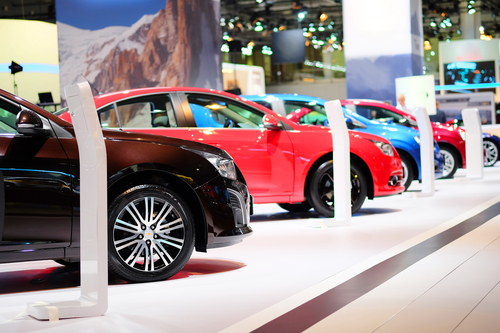
State Development & Investment Corp Ltd. chairman Gao Guohua said Chinese brands had difficulty competing with foreign manufacturers in the past. In the meantime, however, many companies have evolved and are using proprietary software and powertrain components made domestically, Gao added. Li Bin, NIO’s founder, said they have invested about $3.05 billion in research and development since the company’s establishment, as well as the same amount in customer service and brand awareness. NIO now sells more than 10,000 vehicles per quarter.
Meanwhile, numerous high-tech and Internet companies from China teamed up with the automotive industry to promote the joint development of electric vehicles. Alibaba, the Chinese Internet giant, and Chinese automaker SAIC Motor jointly developed the Banma car operating system, which provides intelligent and connected solutions for the entire automotive industry. In the area of CCC certification of automotive parts and vehicles, Chinese requirements are particularly high. The certification of a complete vehicle is a complex project that requires professional support at all stages.
For more information on how CCC certification, the CCC Self-Declaration and voluntary CCAP or CQC certification may affect your company, or for more information about CCC certification in general, the process, and the associated costs, please visit our website and our News Section where you will find current updates twice a week.
Please do not hesitate to contact us for further details and consultation. You can contact us via e-mail, or call us (UK: +44 2071931135, Rest of Europe: +49 69 2713769150, US: +1 773 654-2673).
Please don’t hesitate to also use our chat-window in the bottom right corner if you have any questions. (Please check your browser settings if you can’t see the window)
You can also check out our free CCC-Brochure, which can be downloaded right here as a PDF file or you consult our book (in English) “A Brief Guide to CCC: China Compulsory Certification”, which can be found directly here on Amazon.
Here you can download our brochure about the CCC Self-Declaration.
Here you can download our brochure about the voluntary CCAP or CQC certification.
Robots with 5G connectivity take the spotlight at an industrial conference
As China continues to expand its 5G network, industry is also increasingly discovering the benefits of the technology. A typical application of 5G is connected robots, which are becoming more autonomous and intelligent. For example, at the 2020 China 5G+ Industrial Internet Conference in Wuhan, two particular robots attracted the attention of visitors. The robots welcomed visitors and were able to answer basic questions as well as guide guests to specific locations. The robots are manufactured and operated by Chinese company Cloud Minds, which develops intelligent and cloud-connected robots for human interaction.
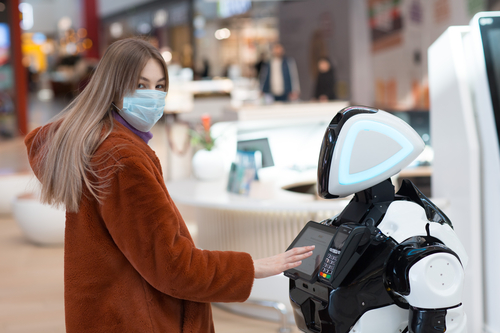
In addition to interactive conversations, the two robots can also complete motion sequences such as handshakes, hugs and dancing. By applying artificial intelligence, cloud computing and 5G technology, the robots can also recognize people’s facial expressions and emotions and engage in dialogue accordingly. Thus, the robots can be used to welcome guests, guide people, and provide entertainment. The actual “thinking” of the robots, or the computational work, is done in a cloud environment and sent in real time using the 5G network.
Last year, when the city of Wuhan was severely affected by the COVID 19 outbreak, Cloud Minds robots assisted workers in hospitals there. The robots were able to ask patients about their symptoms, take their temperature, as well as entertain them during waiting times. According to Cloud Minds, the robots were also successfully used to entertain patients while they were placed in isolation and quarantine areas. Robots are subject to mandatory certification in China. The CCC here stands for China Compulsory Certificate and is comparable to the European CE system, but there are important differences. Products requiring certification may only be imported into China, sold in China and used in business activities in China after the product has undergone CCC certification. We are pleased to advise you on the scope and requirements of a China CCC certification without obligation.
For more information on how CCC certification, the CCC Self-Declaration and voluntary CCAP or CQC certification may affect your company, or for more information about CCC certification in general, the process, and the associated costs, please visit our website and our News Section where you will find current updates twice a week.
Please do not hesitate to contact us for further details and consultation. You can contact us via e-mail, or call us (UK: +44 2071931135, Rest of Europe: +49 69 2713769150, US: +1 773 654-2673).
Please don’t hesitate to also use our chat-window in the bottom right corner if you have any questions. (Please check your browser settings if you can’t see the window)
You can also check out our free CCC-Brochure, which can be downloaded right here as a PDF file or you consult our book (in English) “A Brief Guide to CCC: China Compulsory Certification”, which can be found directly here on Amazon.
Here you can download our brochure about the CCC Self-Declaration.
Here you can download our brochure about the voluntary CCAP or CQC certification.
3 Chinese companies among the top 5 smartphone manufacturers
China’s Huawei, Xiaomi and Oppo occupy three spots among the world’s top five smartphone manufacturers based on shipments in the third quarter of 2020, according to a study released last Monday by consulting firm Gartner. Samsung remains the leader with 80.8 million devices sold and a global market share of 22 percent followed by Huawei with 51.3 million and 14.1 percent.

Xiaomi posted a huge 34.9 percent year-on-year increase and now ranks third with 44.41 million devices shipped or 12.1 percent market share. The Chinese electronics company, which produces numerous other devices for entertainment and the household in addition to smartphones, thus overtook rival Apple and relegated it to fourth place. Apple shipped 40.5 million devices in the third quarter, with Oppo in fifth place with 29.89 million devices.
According to analysis by consulting firm Gartner, a total of 366 million smartphones were shipped worldwide in the third quarter of 2020, a slight decrease of 5.7 percent compared to the previous year. Anshul Gupta, senior analyst at Gartner, shared there are initial signs of recovery in the markets in the Asia-Pacific area as well as Latin America. The return to normalcy in much of China also contributed to the improvement in smartphone production numbers. Current production could make up for supply shortages in the third quarter and drive sales figures further upward in the coming year, Gupta said. Smartphones fall under the CCC certification requirement in China. CCC stands for China Compulsory Certificate. The CCC certificate was introduced in 2002 and applies to both imported and Chinese products.
For more information on how CCC certification, the CCC Self-Declaration and voluntary CCAP or CQC certification may affect your company, or for more information about CCC certification in general, the process, and the associated costs, please visit our website and our News Section where you will find current updates twice a week.
Please do not hesitate to contact us for further details and consultation. You can contact us via e-mail, or call us (UK: +44 2071931135, Rest of Europe: +49 69 2713769150, US: +1 773 654-2673).
Please don’t hesitate to also use our chat-window in the bottom right corner if you have any questions. (Please check your browser settings if you can’t see the window)
You can also check out our free CCC-Brochure, which can be downloaded right here as a PDF file or you consult our book (in English) “A Brief Guide to CCC: China Compulsory Certification”, which can be found directly here on Amazon.
Here you can download our brochure about the CCC Self-Declaration.
Here you can download our brochure about the voluntary CCAP or CQC certification.
Xiaomi posted 34 percent increase in third quarter revenue
Xiaomi Corporation, a Chinese smartphone manufacturer, recently announced its latest financial results. Revenue in the third quarter of 2020 was around $11 billion, up 34 percent year-on-year and also the highest revenue growth in two years. However, Xiaomi President Wang Xiang expressed concerns of supply chain shortages for the industry as a whole. Despite this challenge, he said he was still confident that his company would end the year with satisfactory results.
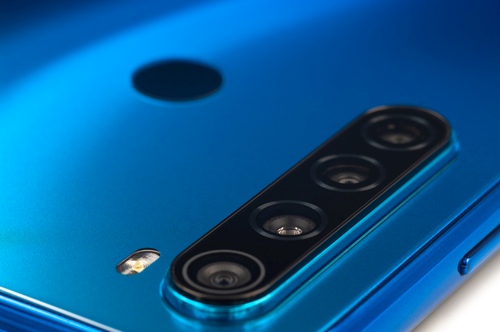
According to analysts, Xiaomi smartphone sales increased due to a decision by the U.S. government to restrict the trade and import of products from rival Huawei Technologies. This was also confirmed by Xiang Ligang, chairman of the Information Consumption Alliance, a telecommunications industry association. According to the China Daily newspaper, U.S. chipmaker Qualcomm Inc. received permission to supply certain products to Huawei’s Chinese sites. Therefore, with Huawei continuing to produce 4G smartphones, Xiaomi expects to face strong competition in overseas markets such as Eastern Europe, Russia, the Middle East and Africa in the coming year, where 4G cell phones continue to be in demand.
Xiaomi said it shipped 46.6 million devices from July to September, up 45.3 percent from the same period last year. Among those, more than half of the third-quarter sales were generated in Europe. Growth in that market was 52.1 percent, with revenue totaling $6 billion. Xiaomi’s adjusted net income in the third quarter was $627 million, above expectations of $504 million. It is worth noting that Xiaomi’s business in Internet services such as music and video streaming grew only 8.7 percent compared to 29 percent a year earlier. Electronic devices such as smartphones may only be imported into China, sold in China and used in business activities in China after the product has undergone CCC certification.
For more information on how CCC certification, the CCC Self-Declaration and voluntary CCAP or CQC certification may affect your company, or for more information about CCC certification in general, the process, and the associated costs, please visit our website and our News Section where you will find current updates twice a week.
Please do not hesitate to contact us for further details and consultation. You can contact us via e-mail, or call us (UK: +44 2071931135, Rest of Europe: +49 69 2713769150, US: +1 773 654-2673).
Please don’t hesitate to also use our chat-window in the bottom right corner if you have any questions. (Please check your browser settings if you can’t see the window)
You can also check out our free CCC-Brochure, which can be downloaded right here as a PDF file or you consult our book (in English) “A Brief Guide to CCC: China Compulsory Certification”, which can be found directly here on Amazon.
Here you can download our brochure about the CCC Self-Declaration.
Here you can download our brochure about the voluntary CCAP or CQC certification.
 We are part of the CERTANIA-Group.